
Green DeWitt's colony plants Gonzales on the Guadalupe, the first settlement burns, and the town returns, fortifies, and grows.
Narrative History
Gonzales and the Fire It Lit
A Narrative History of Gonzales, Texas, and the Story Told Inside Texas Legacy in Lights.
Gonzales got its legend before it got its comfort. It got trouble before it got peace. This page follows the town from the DeWitt Colony and the first hard years on the Guadalupe through the cannon dispute, the first shot, the Alamo connection, the burning of the town, the Runaway Scrape, and the way Texas Legacy in Lights turns all of that history into living public memory.
What Texas Legacy in Lights Is
The story begins before the famous battle, in the early days of Gonzales itself. Long before Texas became a republic, families pushed into this frontier country to build homes, claim land, and carve out a life along the Guadalupe. Gonzales grew out of the DeWitt Colony and stood on the western edge of Anglo settlement, exposed to danger, hardship, and uncertainty. That rough setting matters, because the show is not just about one cannon. It is about the people who chose to stay, build, love, and risk everything here.
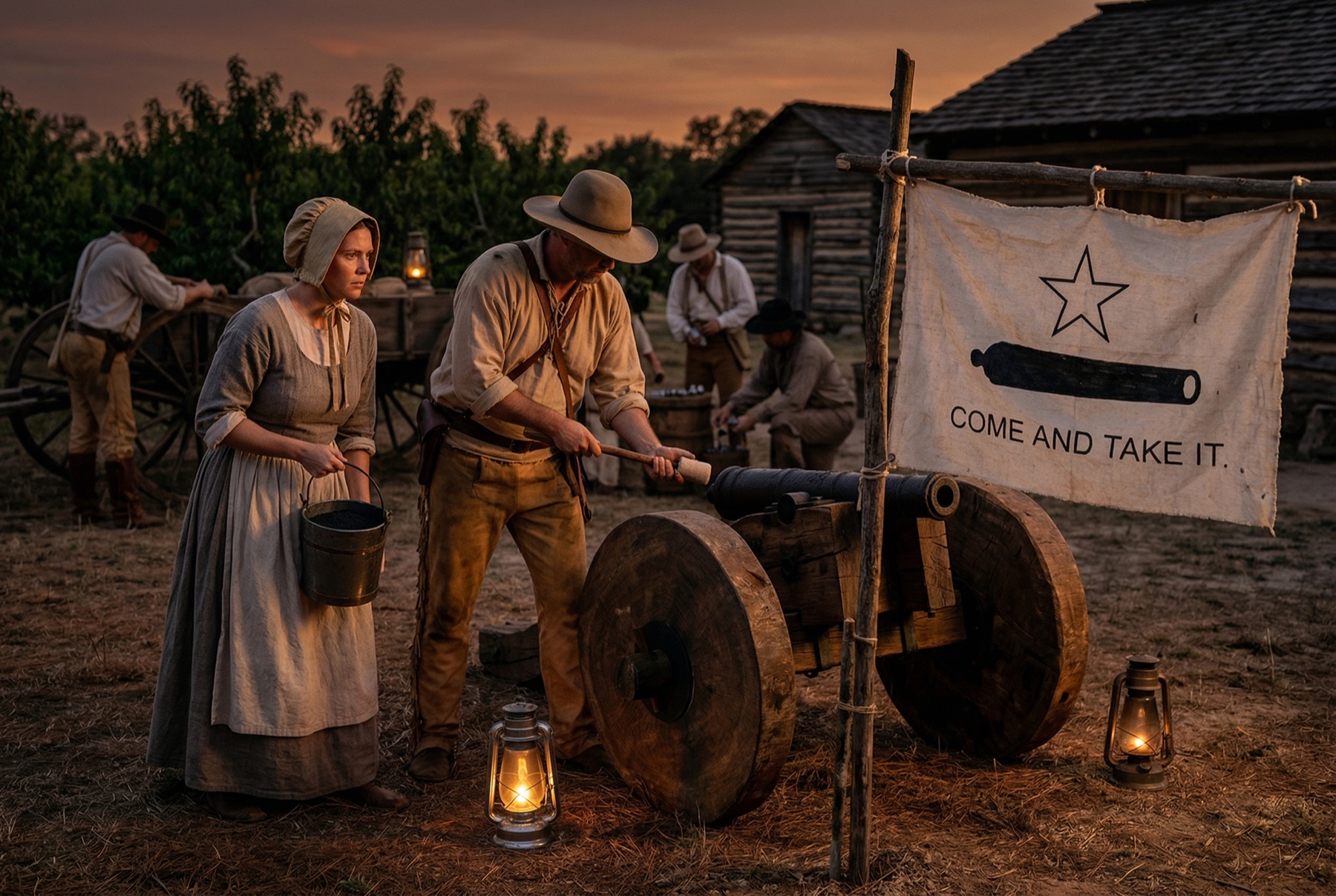
Then the pressure closes in. Mexican authorities demanded the return of the small cannon that had been kept in Gonzales for defense. The people of the town refused. What followed became the Battle of Gonzales on October 2, 1835, remembered as the first military clash of the Texas Revolution. That is the moment the show drives toward with real force. Visitors see the fear, the defiance, the gathering of volunteers, the rise of the Come and Take It spirit, and the shot that helped set a revolution in motion. Gonzales is presented not as a footnote, but as the place where the fight truly began.
But Texas Legacy in Lights does not stop at victory or myth. It follows the cost. The show moves from young love and frontier hope into war, loss, and sacrifice. It connects Gonzales to the Alamo, where men from this town answered the call and rode into a fight they knew might be their last. It carries that grief forward into the burning of Gonzales and the desperate flight of families during the Runaway Scrape, when homes were destroyed so the enemy would find nothing but smoke and ash. That turn gives the show its heart. It is not only about bravery. It is about what ordinary people lost to give Texas a future.
What people experience, then, is more than a history lesson. They are standing in the town where these events happened, watching the museum become a memory keeper for the people who lived them. The installation was planned as a 20 minute visual storytelling loop with reenactments, historical imagery, narration, and a musical score meant to educate, move, and inspire. It gives visitors a reason to see Gonzales not just as a stop on the map, but as one of the most important starting points in Texas history.
Timeline
The Gonzales story moves from frontier settlement to first refusal, sacrifice, fire, and remembered identity.
Start with the show summary above, move through the sequence here, then read the full long-form article below.
The Gonzales Story
The cannon arrives for local defense while trust in Mexican rule frays under centralization, troop movements, and growing local alarm.
Mexican troops demand the cannon back. Gonzales stalls at the river, hides the ferries, gathers riders, and draws a countryside into motion.
Come and Take It fires the first shot of the Texas Revolution and turns Gonzales into the first refusal that made everything else possible.
Gonzales men ride on to the Alamo with the Immortal 32, die there, and leave the town to face grief, fire, and retreat.
The town burns in the Runaway Scrape as women, children, and the vulnerable flee east through cold, mud, hunger, and fear.
Gonzales rebuilds, carries its beginning as identity, and retells that memory in projected light through Texas Legacy in Lights.
Green DeWitt's colony plants Gonzales on the Guadalupe, the first settlement burns, and the town returns, fortifies, and grows.
The cannon arrives for local defense while trust in Mexican rule frays under centralization, troop movements, and growing local alarm.
Mexican troops demand the cannon back. Gonzales stalls at the river, hides the ferries, gathers riders, and draws a countryside into motion.
Come and Take It fires the first shot of the Texas Revolution and turns Gonzales into the first refusal that made everything else possible.
Gonzales men ride on to the Alamo with the Immortal 32, die there, and leave the town to face grief, fire, and retreat.
The town burns in the Runaway Scrape as women, children, and the vulnerable flee east through cold, mud, hunger, and fear.
Gonzales rebuilds, carries its beginning as identity, and retells that memory in projected light through Texas Legacy in Lights.
Prepared for Web Adaptation
Gonzales and the Fire It Lit
A Narrative History of Gonzales, Texas, and the Story Told Inside Texas Legacy in Lights
There are towns in Texas that got rich first and famous later. There are towns that got a railroad, a courthouse, or an oilfield, and then spent the next hundred years calling that good luck destiny. Gonzales is not one of those towns. Gonzales got its name before it got its comfort. It got its legend before it got its sidewalks. It got trouble before it got peace. The place was born with a river on one side, wild country on the other, and a habit of being asked to prove itself.
That is still the feel of the town if you come in slow enough to notice it. The Guadalupe does not hurry for anybody. The old stories hang close to the ground. The flag is not merely a flag there. It is a dare, a joke, a memory, a bit of inherited stubbornness. In some towns history is tucked away in a locked case, dusted once in a while, and brought out for schoolchildren. In Gonzales history still walks around in daylight. It is painted on walls. It is spoken at festivals. It is sold on shirts and coffee cups. It is half civic pride and half family inheritance. A person can smile at that if he wants, but the thing did not come from nowhere. It came from men and women who found themselves planted on a dangerous edge of Mexican Texas and decided, one rough morning in 1835, that they would not be pushed any farther.
To tell the story of Gonzales right, you cannot begin with the famous cannon and think you have done enough. The cannon matters, of course. The flag matters. John Henry Moore matters. The Old Eighteen matter. But those things make sense only if you understand the country that raised them, the bargains that failed around them, and the people who had already learned what frontier life cost before any Mexican dragoon rode to the river asking for artillery. The story is not only about a first shot. It is about a town that learned early that paradise and danger often arrive by the same road. That is why the story works so well on the museum walls in Texas Legacy in Lights. It is not merely a sequence of facts. It is memory under pressure. It is hope with smoke in its lungs. It is love trying to live in a place where history keeps breaking through the door. The project's own story framework says the museum itself serves as a memory keeper, that narration should feel like memory rather than textbook fact, and that each scene should either break the heart or light a fire. That is the right instinct for Gonzales. It is not a place you explain coldly and still expect anyone to understand.
Long before Gonzales became shorthand for defiance, it was simply a hard piece of country that looked full of promise to men who had not yet paid for the privilege of living there. Under the Federal Constitution of Mexico of 1824, Green DeWitt received authority to settle four hundred families in a stretch of land that ran from near Victoria toward present day Lockhart, and from the Lavaca River westward beyond the Guadalupe. He was one of the most successful empresarios in early Texas. That sort of grant could make a man feel as if heaven itself had signed a land deal in his favor. Land was the great word then. Land meant room. Land meant cattle, crops, children, and the chance that a man might leave his sons more than he himself had been handed. Families came west not because the country was easy but because it was open. A married rancher could imagine a sitio and a labor. A farmer could imagine soil enough to finally belong somewhere. To people who had known crowding, debt, or disappointment in older states, Texas looked like a second creation.
DeWitt's settlers first gathered near the mouth of the Lavaca at a place called Old Station, and then some pushed inward toward Kerr Creek, on the eastern edge of what would become Gonzales. James Kerr, Erastus “Deaf” Smith, and the men with them had chosen the townsite because the land was rich, the game plentiful, the timber useful, and the water close. They found the meeting of the Guadalupe and San Marcos waters and thought, with good reason, that a town might stand there for a very long time. They named it for Rafael Gonzales, provisional governor of Coahuila y Texas. Even that beginning carried a kind of balance in it. The settlement was Anglo in population, Mexican in legal authority, and frontier in actual conditions. Everybody was trying to build a future under one flag while already sensing that different futures were being imagined.
The frontier wasted no time in showing its teeth. In July of 1826, while many of the settlers were away, Indians attacked and burned the little settlement at Kerr Creek. John Wrightman was killed. The colonists fled to Austin's colony where the country was safer. That first effort at Gonzales did not end in triumph or romance. It ended the way many frontier beginnings ended, with smoke, loss, and the lesson that a map and a legal grant were one thing while a livable home was another. When the settlers returned in 1827, they did so with a clearer mind about what kind of place this was. They built a fort near what are now St. Louis and Water Streets. In other words, Gonzales was from the start a town that knew how to pray over a plow while keeping an eye on the tree line.
By 1828 there were seventy two colonists listed in the DeWitt Colony census, and by 1831 the population had grown to roughly 531 residents. Titles were being issued. The town was surveyed into its square of blocks and public squares. Homes, shops, a rough civic life, and ordinary ambitions began taking form. This matters because a legend is easier to make out of a battlefield than out of a settlement ledger, yet the ledgers tell you what was really at stake. These were not merely men looking for a fight. They were people who had laid out streets, marked lots, raised children, and built businesses. They had begun the slow work every community does when it tries to convince itself it will last. That is why later defiance had weight. A man stands differently for a town that has already put its roots down.
Still, the balance between Mexico and the colonists grew uneasy. The settlers had accepted the Federal Constitution of 1824. They had sworn obedience, pledged Christian faith, and expected that within that arrangement they could prosper in relative peace. But the constitutional government of Mexico was abolished in 1830. New laws limited immigration from the United States, imposed customs duties, and sent more Mexican troops into Texas. Colonists who had grown used to handling their own affairs saw in these changes not orderly government but encroaching control. The relationship had never been simple, but now it became harder to pretend the strains were temporary. DeWitt himself suffered for it. His six year colonization contract expired. He went to Mexico trying to secure an extension, failed, contracted cholera, and died there. A town founded by his ambition was left to continue without him. The dreamer was gone. The country remained.
Before his death, Green DeWitt had asked the Mexican government for a cannon to help defend the settlement against hostile Indians, and the request was granted. Men from Gonzales went to Bexar and brought back the small piece of artillery. It was not much of a battlefield instrument. It had been spiked and was of limited military use. But it could make noise, and noise mattered on the frontier. More than that, it became a symbol of local right. Whether it had been loaned or given in perpetuity became one of those questions that history loves because law and feeling do not always agree. What matters is that the settlers believed it was there for their defense, and by 1835 defense meant more than Indians. It meant the whole question of whether free men in Texas would keep the means to guard their own homes.
By then Gonzales occupied a dangerous middle place. It sat on the far western edge of Anglo settlement, nearer to Mexican military power in San Antonio than most of the louder political talkers back east at San Felipe. The so called War Party could speak boldly from safer ground. Gonzales would be among the first to pay if speaking turned into shooting. For a long while the town remained comparatively loyal to Mexico. Its people were not eager for rash insurrection. They disapproved of the Fredonian disturbance years earlier because they did not want disorder to cost them their land or their future. Even in the early 1830s many settlers still hoped accommodation might be possible. They wanted liberty and local control, yes, but they had not all started out wanting outright separation. That makes what happened next more important, not less. Gonzales did not rush to rebellion because rebellion sounded romantic. It was driven toward it by accumulating proof that the old arrangement could not be trusted.
Committees of Safety began forming. Gonzales organized one in May of 1835, naming men like James B. Patrick, W. W. Arrington, George W. Davis, James Hodges Sr., John Fisher, Bartlett McClure, and Andrew Ponton. The Gonzales militia elected officers in July, including Captain Albert Martin, Lieutenant William Arrington, Lieutenant Jesse McCoy, Lieutenant Charles Mason, and Orderly Sergeant Valentine Bennet. Men such as George W. Cottle, James Neill, James Fannin, and J. W. E. Wallace were also among the volunteers. That is the kind of detail a casual reader may skip over, but it reveals something essential. Towns do not suddenly become war towns in a single dramatic instant. They edge there by meetings, elections, rumor, and the repeated, uneasy habit of preparing for something they still pray will not happen.
One incident in September of 1835 cut deep in Gonzales. At Adam Zumwalt's storeroom, a Mexican soldier beat the town sheriff, Jesse McCoy, over the head with a rifle for no apparent reason. Perhaps in another place it might have been written off as the drunken cruelty of one soldier. On a frontier already full of rumor and mistrust, it felt larger than itself. Men remember an insult to their sheriff. They remember a blow struck in public. The town was already hearing that Santa Anna intended to impose military rule in Texas, perhaps even replace Anglo settlers with Mexican families. Edward Gritten came from Mexico assuring the people they were in no danger, and Colonel Ugartechea sent a letter saying he was not sending troops to govern them. The colonists were reassured enough that copies of the letter were being distributed to nearby settlements. Then came the demand for the cannon, and whatever calm that letter had purchased vanished in a day.
Late September is where the old town story tightens like a cinch. On September 25, 1835, four Mexican soldiers under Corporal DeLeon approached Gonzales to retrieve the cannon. They reportedly brought a cart for hauling it back to Bexar. The Mexican soldiers stopped on the west bank of the Guadalupe. The ferry and all other watercraft had been removed and hidden. The officials of Gonzales stalled for time while messengers rode out in every direction toward Mina, the Lavaca, Victoria, and the Colorado settlements. The townspeople knew exactly what their refusal meant. Once they denied the cannon, there would be no smoothing this over with a polite explanation and a handshake. They had crossed into a different kind of history.
Andrew Ponton, the alcalde, replied to the first demand with the kind of frontier diplomacy that deserves more admiration than it usually gets. He wrote that the matter was delicate, that the cannon had been given for defense against Indians, that the need for defense still existed, and that he hoped to be excused from delivering it until he had obtained further information and consulted higher authority. It was courteous language covering iron purpose. Meanwhile only eighteen men were in town ready to defend the cannon if pressed. Those names still deserve to be said aloud: Albert Martin, Jacob Darst, Winslow Turner, W. W. Arrington, Graves Fulchear, George W. Davis, John Sowell, James Hinds, Thomas Miller, Valentine Bennet, Ezekiel Williams, Simeon Bateman, J. D. Clements, Almeron Dickinson, Benjamin Fuqua, Thomas Jackson, Charles Mason, and Almon Cottle. Gonzales remembers them as the Old Eighteen. There is something deeply Texan about that phrase. It does not sound grand or polished. It sounds like people who simply stayed when leaving would have been easier.
Colonel Ugartechea did not take the answer well. He sent Lieutenant Francisco Castañeda from Bexar with around one hundred men, authorized to avoid needless confrontation if possible but empowered to arrest those who resisted. The cannon was buried in George W. Davis's peach orchard for safekeeping. More volunteers rode into Gonzales. Men came from Mina under Robert Coleman and John Tumlinson. Others came from the La Grange area, from the Navidad and Lavaca, from Brazoria, Columbia, Old Caney, and Victoria. By the time Castañeda reached the vicinity of the river, the little argument over one spiked cannon had drawn a whole countryside into motion. That is often how turning points happen. They do not announce themselves as turning points. They look like one local dispute too small to matter until every road begins feeding men into it.
Castañeda's position was difficult. He demanded to see Ponton and to obtain the cannon, but he had to deal with delay after delay. The river held him off as effectively as a fort wall. Messages were shouted across the water or carried by a soldier who swam the Guadalupe. Joseph Clements, acting in Ponton's absence, sent back the famous reply that the right of consulting their political chief seemed denied them and that therefore he could not and did not desire to deliver up the cannon. He added that though they were weak and few in number, they were contending for what they believed to be just principles. That is one of those lines that survives because it tells the truth of the moment without overreaching. They were weak. They were few. They were also done yielding.
By the last night of September, more than 150 volunteers had arrived. Leaders were elected by popular vote. John Henry Moore was chosen colonel, with J. W. E. Wallace as lieutenant colonel. Robert M. Coleman, Albert Martin, and Edward Burleson became captains. Castañeda moved upriver searching for another crossing and camped near Ezekiel Williams's place. The Texans dug up the cannon, mounted it on wheels, and prepared to strike. Tradition holds that Sarah Seely DeWitt and her daughter Evaline fashioned the famous flag from Naomi DeWitt's wedding dress. Whether a person emphasizes the exact sewing details or not, the image has lasted because it says something true about Gonzales. Even in public memory the town understands that women stood inside this story from the beginning, turning household cloth into open challenge. The flag was not stitched in a war department. It was stitched in a home.
Creed Taylor later described the volunteers moving out that night in buckskin breeches, hunting shirts or jackets, coonskin caps and sombreros, some in moccasins, all carrying long flintlock rifles, powder horns, shot pouches, knives, and in some cases pistols. It was not the polished look of a formal army. It was frontier men carrying the tools they had and whatever courage they could gather. Reverend W. P. Smith gave them a speech before they crossed the river on the evening of October 1. The old quotation preserved from that night says everything was at stake: their firesides, their wives, their children, their country, their all. Good rhetoric lasts because it is close to fear. That one was.
The battle itself, on the morning of October 2, 1835, was brief and clouded by fog, confusion, and legend. Before dawn the Texans formed. Mexican soldiers fired. One Texan was hurt when his horse threw him. The Texans fired back and wounded a Mexican trooper. There was maneuvering, fog, scattered volleys, and then a meeting in the field between Moore and Castañeda. Moore told him plainly that the Mexican troops represented Santa Anna, and Santa Anna was now an enemy to the colonists. He urged Castañeda to join the Texans in support of the Constitution of 1824 or prepare to fight. Castañeda said he had orders and must obey them. Moore pointed to the cannon and, in essence, invited him to come and take it. Then came the order to fire. The little cannon roared. The Mexican force withdrew toward San Antonio. On paper it was a minor skirmish. In memory it was the crack of a door being kicked open.
Texas history has always loved the Alamo, and rightly enough. It loves Goliad because blood memory is hard to forget. It loves San Jacinto because a people naturally cherish the moment their gamble paid off. But Gonzales occupies a different place. It is not the martyrdom, not the massacre, not the victory lap. It is the first refusal that made all the others possible. Your own commercial scripts say it plainly. The Alamo may be dramatic, Goliad important, San Jacinto triumphant, but you do not get the last stand, the sacrifice, or the victory without the first real fight. Gonzales is the town that said no first. That is why it can sound half amused and half proud when it calls itself first. The joke works because the history beneath it is solid.
The Battle of Gonzales did not end the matter. It started it. Men stayed under arms. Stephen F. Austin arrived in Gonzales on October 11 and was chosen commander in chief of the Texan forces. On October 12 the troops marched out of Gonzales toward San Antonio. Along the way came Goliad, the siege operations around Bexar, the Grass Fight, and the eventual surrender of General Cos in December. For a moment, some volunteers went home for Christmas. War often tricks people that way. It gives them one small exhale and lets them imagine maybe the worst has passed. It had not. By late February of 1836, Texans were holding the Alamo. On March 1 the Immortal Thirty Two from the Gonzales area slipped through enemy lines and entered that doomed mission, joining other Gonzales men already inside. When the Alamo fell on March 6, they died with the rest. Gonzales paid dearly for being first.
Any honest history of the town has to pause there and let the weight sit. For all the later merchandising and bravado attached to the phrase Come and Take It, the original town did not win its name without graves. It lost men at the Alamo. It lost security. It lost, for a while, the ordinary right to remain in its own houses. On March 11 Sam Houston arrived in Gonzales amid reports of the Alamo's fall. Two days later, with Santa Anna advancing and the danger of massacre real, Houston ordered the women, children, and noncombatants eastward. Then Gonzales was burned by its own people so the Mexican army would find nothing useful there. The show script Texas Legacy in Lights opens with that fire, and that is not an accident. It understands that to tell Gonzales honestly you begin not with the pleasant pageantry of the flag but with a town watching its own rooflines catch. The script gives that moment to Evaline's memory, and memory is the right vessel for it because what burned there was not merely lumber. It was domestic life. It was expectation. It was the shape of normal days.
The Runaway Scrape remains one of the hardest chapters in Gonzales history because it belongs less to victory mythology than to raw human suffering. Histories preserve the details because the details refuse to let the story turn neat. The weather was bitter, wet, and cold. The roads were mud and often not roads at all. The refugees were not a marching army but widows, children, the elderly, pregnant women, the sick, and the terrified. They abandoned furniture, pots, clothing, and whatever else had to be left in order to move faster. Some people died of exposure, hunger, or exhaustion. Virginia Page, only two years old, is remembered as one of the children lost on that miserable retreat. Sarah Eggleston was fifteen and eight months pregnant. Nancy Cottle was pregnant with twins. Elizabeth Kent had nine children to guard and feed. Blind Mary Millsaps had seven. You cannot read those names and still imagine the Texas Revolution as a clean tableau of mounted men under bright banners. Gonzales carried war in women's arms and children's graves.
That, too, lives inside Texas Legacy in Lights. The project narrative states that the core purpose of the installation is to tell not only the Battle of Gonzales but also the founding of the DeWitt Colony, Comanche raids, and the tragic burning of Gonzales. The visual storytelling is planned as a 20 minute loop using reenactment footage, historical imagery, narration, and a custom musical score. The show is meant to educate, yes, but also to move people. In that sense it is less like a lecture than like a town remembering out loud. It uses the museum facade as a great public face of memory. It lets history walk back onto the grounds where it still belongs.
What makes the show especially smart is that it does not try to carry the whole burden with dates and proclamations alone. It uses a core ensemble. Evaline is the heart. John B. Gaston is the flame. William Philip King is the innocent. Thomas Jackson is the anchor. Sarah DeWitt is the backbone. John Henry Moore is the catalyst. Those labels are blunt, but useful. They tell you what the piece is trying to do. It is taking a public story and giving it faces. That is how memory actually works. Most people do not carry history in neat timelines. They carry it through a mother's voice, a young man's foolish courage, a boy's hunger to prove himself, an older man's hard won warning, the look of a leader on horseback, the sound of a town on the move. The rules document for the script insists that every character must be a face to remember or no one will be. That is not only a filmmaking rule. It is a principle of local history. The town survives in faces before it survives in monuments.
Evaline DeWitt is an especially telling choice. In the character material she is a fiery seventeen year old shaped by her strong willed mother and her dreamer father. In the show's arc she begins with hope and love, loses her father, watches the town brace for war, sees John B. Gaston go off toward the Alamo, and then endures the Runaway Scrape and the burning of Gonzales. By the time Texas wins independence, she is no longer the same girl. That is not merely a melodramatic device. It is the emotional logic of the town itself. Gonzales before late 1835 and Gonzales after spring of 1836 are not the same place. The show lets one young woman's life bear the imprint of that transformation so the audience can feel the town growing older under duress.
John B. Gaston carries another side of the story. In the character sheets he is seventeen, in love with Evaline, hot headed, dutiful, and hungry to become worthy in the eyes of family and community. In the arc material, the Battle of Gonzales changes him. Watching John Henry Moore command under pressure gives him a sense of greatness beyond romance. He wants to be part of history. He wants to be a man. He mistakes passion for readiness. By the time he rides toward the Alamo, he believes in the old dream that courage will surely be met by rescue. At the end he dies realizing he misunderstood both war and responsibility. That is good storytelling because it catches a truth the Revolution produced again and again. Frontier courage was real, but so was frontier innocence. The boys of Gonzales did not all know what kind of machine they were stepping into.
William Philip King sharpens that tragedy even more. He is only fifteen in the character material, eager to prove himself, full of destiny, too young to understand the force gathering against him. Gonzales history is full of proud names and public gestures, but stories survive partly because they hold the young where you can see them. When a town sends men to a doomed defense, and one of them is a boy straining to be treated like a man, the whole event changes shape in memory. It stops being only a political contest and becomes an inheritance of grief. That is why William Philip King has captured the imagination for so long. He is the moment when public glory and private heartbreak become impossible to separate.
Thomas Jackson's role in the show is perhaps the most quietly wise. He is the gruff older man, the trainer, the one who understands more than the young men do. His arc material describes him as almost a father to the lost boys of Gonzales, one of the few who understands what the Alamo really means and who chooses to go with them because, if they are determined to die, he will at least see that they do not die alone. Whether or not every detail in that dramatic rendering maps one for one onto documented history is not the main point. The main point is that the show recognizes something fundamental about frontier communities: youth rarely walks into war unaccompanied. There is almost always some older hand nearby, cursing, warning, and then saddling up anyway because love and responsibility will not let him do less.
Sarah DeWitt, too, is more than a supporting figure. In the show she is the backbone, the woman who tears up the wedding dress, helps create the flag, steadies her daughters, and keeps moving when panic would be easier. History often gets told from horseback, but towns are kept alive from kitchens, wagons, and muddy roads. The image of Sarah repurposing a white dress into a battle flag is one of those perfect frontier images because it contains two worlds at once. There is marriage cloth in it and war cloth in it. There is home in it and public defiance in it. There is no cleaner symbol for what Gonzales became in those days: domestic life converted by necessity into open resistance.
Then there is John Henry Moore, who in the show and in the historical material stands as the catalyst. He is the figure who turns private unease into public action. The character sheet rightly treats him as commanding, strategic, and morally certain, a man whose presence signals that history is shifting around him. Historically he was elected commander of the Texian force at Gonzales and played the central leadership role in the battle. Dramatically he is the sort of man every frontier crisis seems to summon: not necessarily the most polished or philosophical, but the one whose clarity gives others their courage. In a place full of rumor, fear, and argument, such a man matters enormously. A town can talk itself into paralysis. Sometimes it takes one voice to turn all that talk into movement.
What Texas Legacy in Lights does, then, is not replace history with fiction. It translates public history into emotional history. It takes the things documented in your Gonzales materials, the DeWitt Colony, the first settlement at Kerr Creek, the return and fortification of the town, the rising strain with Mexico, the demand for the cannon, the Battle of Gonzales, the Alamo connection, the burning of the town, and the Runaway Scrape, and then threads those things through a handful of remembered faces. That is what the best local storytelling has always done. It does not deny the large event. It keeps the large event from swallowing the human beings who had to live through it.
A dry civic article might stop there and declare the job done. It would say Gonzales is important because it was the birthplace of the Come and Take It spirit, because it played a pivotal role in the Texas Revolution, and because the new projection mapped installation will attract year round visitors. All that is true. The case statement for the project says exactly that. It frames Texas Legacy in Lights as a permanent multimedia installation that can generate tourism, support local business, provide educational value, and strengthen civic pride. It projects more than 20,000 annual visitors, over $1 million in direct visitor spending, and increased overnight stays and tax revenue. Those claims matter, especially if one is asking a city, donors, or sponsors to help fund an ambitious public attraction. But if that is all you say, you have told only the accountant's version of Gonzales. The soul of the place is older and rougher than any spreadsheet.
The deeper truth is that Gonzales has always been a town where public memory performs practical work. Its history is not simply ornament. It is leverage. It tells the town who it is when times are hard. It gives schoolchildren a sense that they come from someplace with grit in it. It gives visitors a reason to stop and stay rather than merely pass through on the way to San Antonio or Houston. It gives the present tense a spine. That is why your more playful commercial copy works too. Those scripts lean into dry humor, bragging that Texas history has its favorites but somehow keeps forgetting where it really started. They joke that Gonzales got only a cannon and a flag while other places got bigger monuments. Beneath the humor is a serious claim. Gonzales may not have been the grandest town, the largest battlefield, or the final victory ground, but it was the beginning. It was the spark that turned a grievance into open contest. That is not a minor civic asset. That is identity in concentrated form.
A town like that changes the way it thinks about time. Most places imagine history behind them. Gonzales seems to carry it beside itself. You can feel it in the old phrases that survived. “Weak and few in number.” “Contending for what we believe to be just principles.” “The sword is drawn and it must not be sheathed until Texas is free.” Those preserved lines from 1835 still sound like Gonzales talking in its sleep. They are not polished enough to be propaganda. They are too worn and earnest for that. They sound like people who had run out of ways to postpone the truth. That is why they last.
To walk the Gonzales story through to the present is to see a town that never entirely gave up its frontier cast of mind. It modernized, of course. It got businesses, museums, festivals, public institutions, and the ordinary changes every Texas town undergoes. Yet the old balance remains. Gonzales is still at once hospitable and wary, proud and dry eyed, willing to laugh at itself while guarding the core of its legend fiercely. The place knows that too much polish can make a local story lie. The good versions keep some dust on their boots. They let a joke sit beside a grave. They let a boast sit beside a widow's name. That is why the Leon Hale kind of small town eye and the J. Frank Dobie kind of open country feeling both fit here in principle. Gonzales requires both. It needs a teller who notices the sly turn of local speech and also one who understands what a hard sky and a long road can do to a people.
That same duality shows up in the physical concept of Texas Legacy in Lights. Technically the installation is sophisticated. The narrative and project documents describe high resolution projectors mounted on custom poles, a coordinated LAN connected system, dozens of outdoor speakers in multiple audio zones, and synchronized visuals and sound across the Gonzales Memorial Museum grounds. The technology is current, but the purpose is old. It exists to gather people outdoors in the dark and remind them who stood here before. It lets a historic building become a canvas without permanently altering the structure. That balance is exactly right for Gonzales. The town is not trying to erase the old by dressing it in the new. It is using the new to make the old visible again.
And there is something fitting, almost poetic, about using light for this place. Gonzales began, in the project materials, as a story of fire and light anyway. Torchlight in cabins. Campfires on the prairie. The flare of a cannon. The burning of homes. The embers of the Runaway Scrape. The script rules explicitly say to use light as a cue and to treat narration as memory. That is more than production advice. It is historical wisdom. Light is how frontier people measured danger, shelter, night travel, worship, and alarm. To tell Gonzales now in projected light across the museum is not a gimmick. It is an artistic return to one of the oldest languages the place knows.
A visitor standing before that museum at night will not receive the town the way a textbook student does. He will not be asked only to memorize that Green DeWitt was authorized to settle four hundred families, or that the first Battle of Gonzales occurred on October 2, 1835, or that the town was burned in March of 1836 during the Runaway Scrape. He will be asked to feel a settlement's promise, a mother's resolve, a young man's bravado, a boy's doomed hope, a leader's clarity, and a town's refusal. If the show does its work well, the audience will leave not merely informed but enlisted into memory. They will understand why the phrase Come and Take It never quite turned into quaint decoration in Gonzales. It remained personal.
That matters for Texas at large because Gonzales has long suffered the fate of beginnings. Beginnings are often honored in speeches and then overshadowed by larger climaxes. Everybody remembers where the hero fell and where the banner was finally planted. Fewer remember where the first little act of resistance made the later heroism necessary. Yet beginnings carry a different kind of moral weight. They happen before outcome is visible. They take place when men are still weak and few, when the cause is still a gamble, when the future does not yet offer the comfort of retrospect. Gonzales stood when no one could prove standing would work. That is why the town deserves more than token mention in any telling of Texas independence.
It also deserves to be told broadly and well because the Gonzales story contains more than martial pride. It contains the full frontier ledger: settlement, loss, negotiation, insult, community organization, local leadership, youthful love, rash courage, maternal strength, exile, hunger, grief, and endurance. Too many public histories shrink such stories into a single famous object. Gonzales is not just a cannon. It is not just a slogan. It is a whole civic drama compressed into one phrase. Behind the flag there is a colony. Behind the colony there is a founder who died trying to secure its future. Behind the battle there are women ripping cloth and men hiding ferries. Behind the glory there are muddy graves on the road east. Texas Legacy in Lights has the chance to restore all that hidden volume to the public imagination.
In one sense, then, the show is a tourist attraction. It is meant to draw people, keep them in town longer, and strengthen Gonzales as a heritage destination beyond the seasonal pull of the Come and Take It festival. The project documents say exactly that. The city has long had strong historic assets, from the memorial museum to downtown and the river, but it has lacked enough year round attraction power to maximize overnight stays and sustained tourism spending. Texas Legacy in Lights is designed to answer that problem by turning the museum and its grounds into a permanent nighttime storytelling experience. This is practical, and practicality should not be sneered at. A town that remembers its dead well may also prefer to keep its storefronts open.
In another sense, though, the show is a public act of moral housekeeping. Communities need places where memory can be tended in common. Not every family preserves the same stories at home. Not every child grows up hearing names like Clements, Ponton, Moore, DeWitt, Gaston, or King spoken around a table. A town wide storytelling installation makes memory communal again. It lets the people of Gonzales stand together under one narrative sky and say: this happened here; this is part of us; these were not abstractions but neighbors in another century. That is especially important in a world where speed flattens place. Projection mapping may be contemporary technology, but in Gonzales it serves one of the oldest local purposes there is: gathering the living around the dead without surrendering either to silence.
And perhaps that is the final thing to say about Gonzales. It is not merely the birthplace of Texas independence in the slogan sense, though that claim is rooted in the historical record of the first armed clash of the Revolution. It is also one of those rare places where the beginning has continued to shape the character of the town itself. The first refusal did not stay in 1835. It bred a temperament. It taught Gonzales how to see itself. That is why the phrase shows up everywhere in the humorous scripts and civic branding. It is not always solemn because people who truly own a story are free to joke with it. Only borrowed legends require stiff ceremony all the time. Gonzales can grin at its own myth because it earned it honestly.
So if a person wants the shortest version, here it is. Gonzales began as a frontier settlement in Green DeWitt's colony, took root under strain, grew uneasy under changing Mexican rule, refused to surrender the cannon given for its defense, fired the first shot of the Texas Revolution, sent men on into the larger war, suffered through the Alamo connection and the Runaway Scrape, burned its own homes rather than leave shelter for Santa Anna, and then lived on long enough to turn ordeal into identity. Texas Legacy in Lights tells that story not as a list but as a remembered life. It uses a museum wall, a cast of emblematic characters, music, light, and the old pressure points of grief and courage to remind the town, and everyone else, that Texas did not simply burst full grown out of one famous siege or one sudden battlefield miracle. It began in a place where a small town on the river decided that enough was enough.
That is why Gonzales still matters. Not because it has the loudest story, but because it has one of the truest. It is a story about the exact moment when ordinary life hardens into public resolve. It is about what people will risk when home, self respect, and the future of their children are all tied together. It is about the fact that history does not always begin with triumph. Sometimes it begins with a delay at the river, a buried cannon in a peach orchard, a wedding dress sacrificed for a flag, a foggy morning, and a town that finally says no. In Texas, that has always been enough to light a fire.
If you stand back from the tale a little, you can see why Gonzales produced the kind of people it did. The town was not set in a sheltered pocket. It was planted on a meeting ground of river bottoms, prairie, timber, and uncertain authority. Life there required a person to be practical before he could afford to be eloquent. A house had to be chinked. A fence had to be repaired. A horse had to be watched. Water had to be crossed when it suited the river, not the traveler. A person living on the far western edge of Anglo settlement could not survive long by theory alone. That is why the men of Gonzales later sound so plain in the surviving letters and recollections. They were not trying to write themselves into legend. They were trying to keep hold of ground, kin, and a way of life that still felt very precarious.
The early town plan itself says a good deal. Gonzales was laid out in a square of forty nine blocks, with public squares set aside for churches, schools, parks, and government use. That detail may seem merely administrative, but it reveals that from its early years the settlement imagined itself as something more than a camp. It intended a civic future. People do not mark public squares unless they expect public life. They do not divide lots and settle titles unless they mean to stay. The inner town of Gonzales was a declaration of permanence made in advance of actual safety. It was a people acting as if order would hold long enough for order to matter. That is one reason the later destruction cut so deeply. Burning a settlement hurts more when the settlement had already started thinking of itself as a proper town.
The same can be said for the fort built after the return in 1827. To modern ears, a frontier fort can sound dramatic and martial. In daily life it meant vulnerability made visible. It meant the settlers knew that the country around them had not consented to be tamed. Gonzales was at once blessed by its location and exposed by it. The river gave water and movement. The open land gave pasture and possibility. The very things that made the place worth settling also made it hard to hold. The town's later habit of fierce self definition grew from that early contradiction. You come to love a place differently when it has already tried once to throw you off and you came back anyway.
And then there was the matter of culture and allegiance. Gonzales was never born in a simple national frame. It began under Mexican law. It was named for a Mexican official. Its people included Anglo settlers, Tejanos, and others living under arrangements shaped by a republic that was itself still sorting out its powers. That complexity matters because later retellings can flatten the whole period into a clean contest between Texans and Mexicans, as if identities came pre labeled and ready for conflict. In reality, the early colony years were crowded with bargaining, swearing of oaths, practical cooperation, suspicion, and changing expectations. Even in the Texas Legacy in Lights script, Juan Seguín appears not as an outsider but as part of the moral fabric of the story. That is correct. The Gonzales story belongs inside the wider and more tangled story of Texas, where loyalties, identities, and causes were often braided together before they were ever separated by war.
One reason the September crisis feels so dramatic is that it arrives after years of tension that had not yet broken into open local bloodshed. Gonzales had watched trouble elsewhere. It had heard of Anahuac, Velasco, and Nacogdoches. It had joined conventions and formed a committee of safety. It had seen the constitutional order wobble and then give way under Santa Anna's centralizing power. Yet the town had not altogether ceased hoping that some line might be found short of open revolt. That is why the cannon demand mattered beyond its military value. It struck directly at the colonists' sense of lawful self protection. If the government that had once armed them for defense could now simply remove that protection while troops massed and rumors flew, then the old covenant was not merely strained. It was broken. Gonzales did not resist because a cannon was sacred. It resisted because surrendering it felt like agreeing that free households in Texas would live at the mercy of distant force.
A great many revolutions, when reduced to their central nerve, come down to that same pressure point. People may bear taxes, delays, insults, and muddled laws for a surprisingly long time. But once they decide the power over them no longer intends to let them remain secure in their own homes, patience changes into defiance. Gonzales reached that point in September of 1835. That is why the language of the surviving letters sounds so morally sharp. It is not the language of adventurers seeking romance. It is the language of townspeople who have decided that giving way now means giving way forever.
The old town also benefited from one quiet frontier virtue that seldom receives enough praise: people answered calls. When riders went out from Gonzales to neighboring settlements, men came. They did not all know one another intimately. They did not share one perfect ideology. Some no doubt came out of principle, some out of kinship, some out of resentment, some out of plain local loyalty, and some because the sight of a line being crossed has a way of summoning men who cannot bear to watch it alone. However mixed the motives, the response mattered. By September 30 the town was no longer an isolated pocket of resistance. It had become a gathering point. Gonzales did not merely defend itself. It drew a countryside into alignment.
There is a reason the image of George W. Davis's peach orchard has lasted in local memory. A peach orchard is a domestic thing. It belongs to shade, fruit, and the ordinary hope of harvest. To bury the cannon there was to hide war inside household ground. That is Gonzales in miniature. Again and again the town's history turns on the conversion of domestic space into strategic space. Cabins become shelters or targets. A river ferry becomes a defensive tool. A wedding dress becomes a flag. A peach orchard becomes a magazine of resistance. Later, the whole town itself becomes a thing to be sacrificed for military necessity when its people burn it rather than leave it to Santa Anna. The line between home and battlefield never held still there.
This is one reason the Texas Legacy in Lights emphasis on still images, controlled movement, and scenes blocked like paintings makes artistic sense. Gonzales history is full of tableaux that already feel composed in the mind: a girl with a rag doll before burning homes; Sarah DeWitt at a table ripping wedding cloth into strips; the Old Eighteen on the east bank while Mexican soldiers water horses on the west; Moore and Castañeda meeting in a fog lifted field; a line of refugees in mud under cold rain; a blind woman and her children found hiding in underbrush; Sam Houston watching a town burn for its own survival. These are not merely events. They are images that carry moral force in a single glance. The script rules, which say not to move the camera unless emotion requires it and to treat each scene like a still painting, are really rules about respect. Some stories ought to be looked at squarely before they are hurried past.
Gonzales also rewards a teller who notices its humor without making light of its cost. Local memory there has a dry bend to it. That comes through in your commercial material and in the surviving frontier anecdotes alike. One older man in the script looks back at the burning tavern and remarks that there goes all the good whiskey. It is a grim line and a funny one at the same time. Such humor is not disrespect. It is the kind of speech hard places produce. People who have seen real danger often joke nearest the edge of it. That is another reason a purely solemn tone would fail Gonzales. Too much reverence makes the town sound borrowed. The real place has always kept a straight face only so long before one side of its mouth begins to lift.
It is worth lingering a moment on the Alamo connection because Gonzales paid twice there: once in men and once in memory. The town's volunteers did not go to the Alamo as anonymous fillers in somebody else's story. They went as men who had already chosen their side at Gonzales, who had already tested Mexican resolve and Texian nerve in the first clash. When the Immortal Thirty Two broke through to join the garrison, they carried with them not only reinforcements but the moral thread tying the first stand to the most famous last stand. In that sense Gonzales bookends the emotional arc of the early Revolution. It begins the open conflict and then sends a piece of itself into the place where the conflict becomes immortalized in blood. No wonder the town never accepted being treated like a footnote to San Antonio. It had skin in both stories.
After San Jacinto and the winning of independence, Gonzales did not step into easy peace. The same history that preserves the first shot also records continuing danger from hostile Indians and later incursions and alarms tied to Mexican campaigns in the 1840s. The point is not to wander too far from the core tale. It is to notice that the town's defining habit was not one single burst of resistance but a longer endurance. Gonzales had to live with the consequences of being who it had declared itself to be. It had to rebuild, remember, and keep watch. Towns are not made heroic by one morning only. They are made by what they remain willing to bear after the banners come down.
That helps explain why Gonzales has been so receptive to memory work in the present. A place that has long needed to tell itself who it is will naturally invest in sites, museums, festivals, and now projection mapped experiences that gather and re state that identity. The project documents describe Texas Legacy in Lights as both preservation and economic development, both educational resource and community experience. Those twin purposes fit Gonzales exactly. In such a place, heritage is not some elite afterthought. It is one of the working tools of the town. It helps teach the young, welcome the stranger, steady the old timer, and justify continued investment in a place whose chief wealth has always included meaning as much as money.
There is also a quiet democratic beauty in projecting the story on the museum exterior rather than keeping it tucked away for paying ticket holders alone. A town square history should be seen under the sky if possible. Gonzales began in open air arguments, river crossings, campfires, and road dust. To tell its story outdoors, with people standing shoulder to shoulder, children fidgeting, old folks remembering, and visitors slowly discovering that this small place carries a large inheritance, feels right. The installation's public nature says that the story still belongs to the town before it belongs to interpretation. The museum keeps it, yes, but the community surrounds it. That is a healthy order.
What all of this finally means for a webpage article is that Gonzales must be written as a lived place, not merely a certified historic site. A reader should smell river mud and woodsmoke in it. He should feel how far San Antonio once was and how near it also stood in the minds of settlers listening for cavalry. He should understand that Green DeWitt's colony was not a ready made Eden but a wager. He should see Sarah DeWitt's hands at the cloth and John Henry Moore's horse in the fog. He should understand why a slogan that can look almost comic on modern merchandise once carried the whole weight of house, wife, child, and principle behind it. If he comes away merely informed, Gonzales has been underwritten. If he comes away feeling that he has brushed against the old stubborn pulse of the place, then the telling has done its work.
This is the gift Gonzales keeps offering Texas. It reminds the larger state that history is not born in marble first. It is born in ordinary people deciding they will take one more step and not another. It is born in a town that had every reason to hesitate and still did not yield. It is born in women carrying memory through terror, in boys overestimating themselves, in men underestimating the cost and then paying it anyway, in leaders speaking plain when plain speech is all that remains. And after all the smoke blows away and all the speeches are done, it is born in a community that keeps telling the truth about itself often enough that the truth does not slip loose.
That is why Gonzales remains worth writing about at length. Not because it needs to be inflated into something it was not, but because it was already enough. Enough courage. Enough sorrow. Enough wit. Enough endurance. Enough beginning. Texas needed such a place once. It still does.
There is another reason Gonzales lends itself so naturally to a long narrative instead of a brochure summary. The town contains an argument about Texas itself. Texas likes big endings, big hats, big monuments, big victory speeches. Gonzales, by contrast, makes the case for the power of the early, the local, and the almost overlooked. It says the hinge matters as much as the door. It says the town that first stiffened its back should not be lost behind the town where the final trumpet sounded. That argument has a way of reaching beyond the Revolution. Small towns across Texas often live in the shadow of louder places. Gonzales knows that feeling and turns it into posture. It is the underrated hero not because it begs to be pitied, but because it knows what it did and feels no obligation to apologize for being small while doing it. Your own public facing copy leans into exactly that idea, calling Gonzales the underrated hero of Texas history and insisting that before the Alamo, before Goliad, before San Jacinto, there was Gonzales. That line works because it is not empty boosterism. It is a correction spoken with a grin.
That grin matters. A town can become trapped by its own tragedy if it is not careful. Gonzales has avoided that trap in part by learning how to carry its history with a light enough hand that visitors are invited in rather than intimidated away. The humorous commercials, the civic branding, and the present day pride all suggest a place that understands memory should be living, not embalmed. The Gonzales branding guide speaks in exactly that register, describing the city as deep in the heart of Texas, close to major cities yet marked by small town charm, hospitality, events, and a strong work ethic. The invitation is clear: come and visit, come and live, come and take part. That is the present tense translation of an older defiant phrase. What began as resistance has, over generations, become welcome without surrendering its edge.
This is where Texas Legacy in Lights can do something rare. It can bridge the gap between local inheritance and outsider understanding. A person from Gonzales may arrive with names already ringing in his head from family stories. A person from somewhere else may know little more than the slogan. The show can meet both of them. It can deepen the local and initiate the stranger. It can remind the resident that the old story is still worth seeing with fresh eyes, and it can tell the newcomer that what looks like a quaint small town emblem is, in fact, the compressed memory of a people who once stood in a narrowing place and refused to bend. When a public history work can do that for both audiences at once, it earns its keep beyond any ticket count.
The town's connection to year round heritage tourism is not incidental, either. Gonzales already has a festival season and strong historical recognition around Come and Take It, but the project documents argue that the city lacks a sufficient year round attraction to convert its historic significance into steady tourism and broader economic benefit. That is a practical problem, and practical problems deserve practical answers. Yet it is striking that the chosen answer is not something generic that could be dropped into any town square. It is a public story specific to Gonzales. That means the town is trying to grow by becoming more itself, not less. In a time when many places chase attention by sanding off their own particular edges, there is wisdom in that. Gonzales's best economic strategy may indeed be the same thing as its best cultural strategy: tell the truth about the place vividly enough that people want to come stand where the truth occurred.
And the truth, in Gonzales, remains layered. It is the truth of first settlement and first loss. The truth of promises made under the Constitution of 1824 and then broken under centralizing power. The truth of committees and letters before shots. The truth of one cannon asked for in defense against Indians and then demanded back as politics curdled into force. The truth of the Old Eighteen buying time while riders spread the alarm. The truth of a foggy field where the first shot was fired. The truth of men who marched on and died at the Alamo. The truth of fire set by home hands. The truth of mothers and children dragging themselves east through rain and mud. The truth of a republic won, but won by people who never got to return as they had left. No single monument tells all of that. It takes narrative to hold it together. Gonzales has earned a narrative longer than a plaque.
That may be why even the technical side of the project feels oddly human in this setting. Seventy nine outdoor speakers, eight audio zones, custom poles, underground conduit, synchronized projectors, and careful accessibility design could sound cold on paper. In Gonzales they become the scaffolding for remembrance. Technology is only machinery until it is told what to serve. Here it serves a town story. It serves the idea that a museum facade can become a shared memory wall and that a public square can once again gather under one account of where it came from. There is something heartening in that. Too often technology arrives promising novelty and leaves little behind. Used this way, it arrives in service of continuity.
If the article has done its work, then by now Gonzales should feel less like a stop on a heritage map and more like a living sentence in the long language of Texas. Not the loudest sentence. Not the final one. But the sentence where the meaning first becomes plain. A little town on the river. A colony trying to root itself. A government losing the confidence of its settlers. A cannon buried in a peach orchard. Men gathering in buckskin and doubt. Women turning private cloth into public challenge. A field of fog. A town burning itself rather than feeding an invader. A line of refugees moving east under bitter weather. And after all that, a place still standing, still remembering, still able to laugh a little when it says: if you are going to be known for something, it might as well be something worth taking.
That is Gonzales. First not because it is jealous. First because it was there when the matter turned. First because it paid the opening price. First because it has spent nearly two centuries carrying that truth in public view. Texas Legacy in Lights does not invent that inheritance. It throws it up in light so the rest of us can no longer say we did not see it.